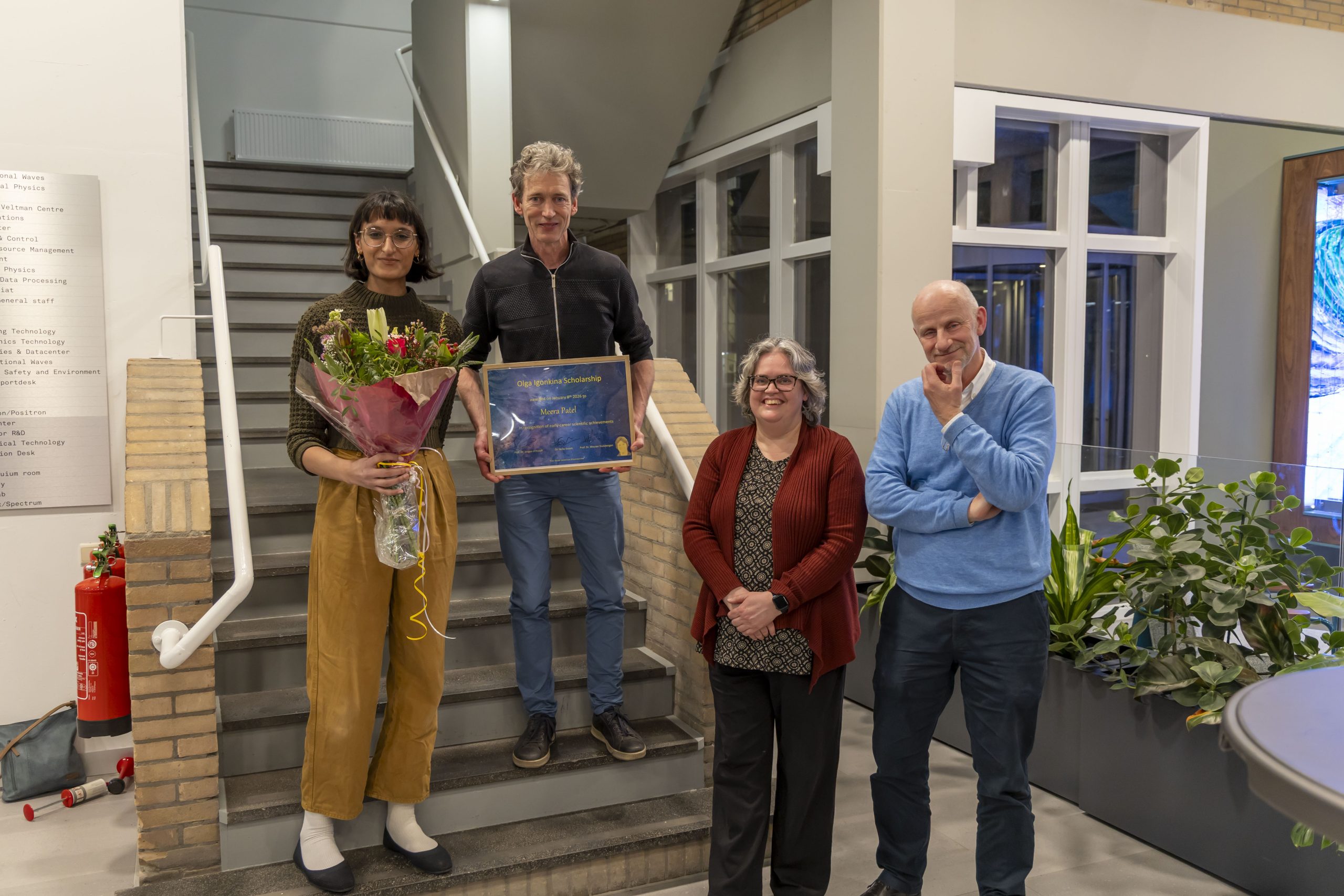
Master’s student in physics Meera Patel has been awarded the Olga Igonkina scholarship 2025 for her work on the dark matter detector XENONnT. The jury announced its decision on Thursday.
After spending her childhood in the US and India, Patel studied physics in Boston and is now doing her master’s degree at the University of Amsterdam at Nikhef in Amsterdam. For the past year and a half, she has been conducting research in Tina Pollmann’s Dark Matter group on background signals caused by fluorescence in the XENON detector.
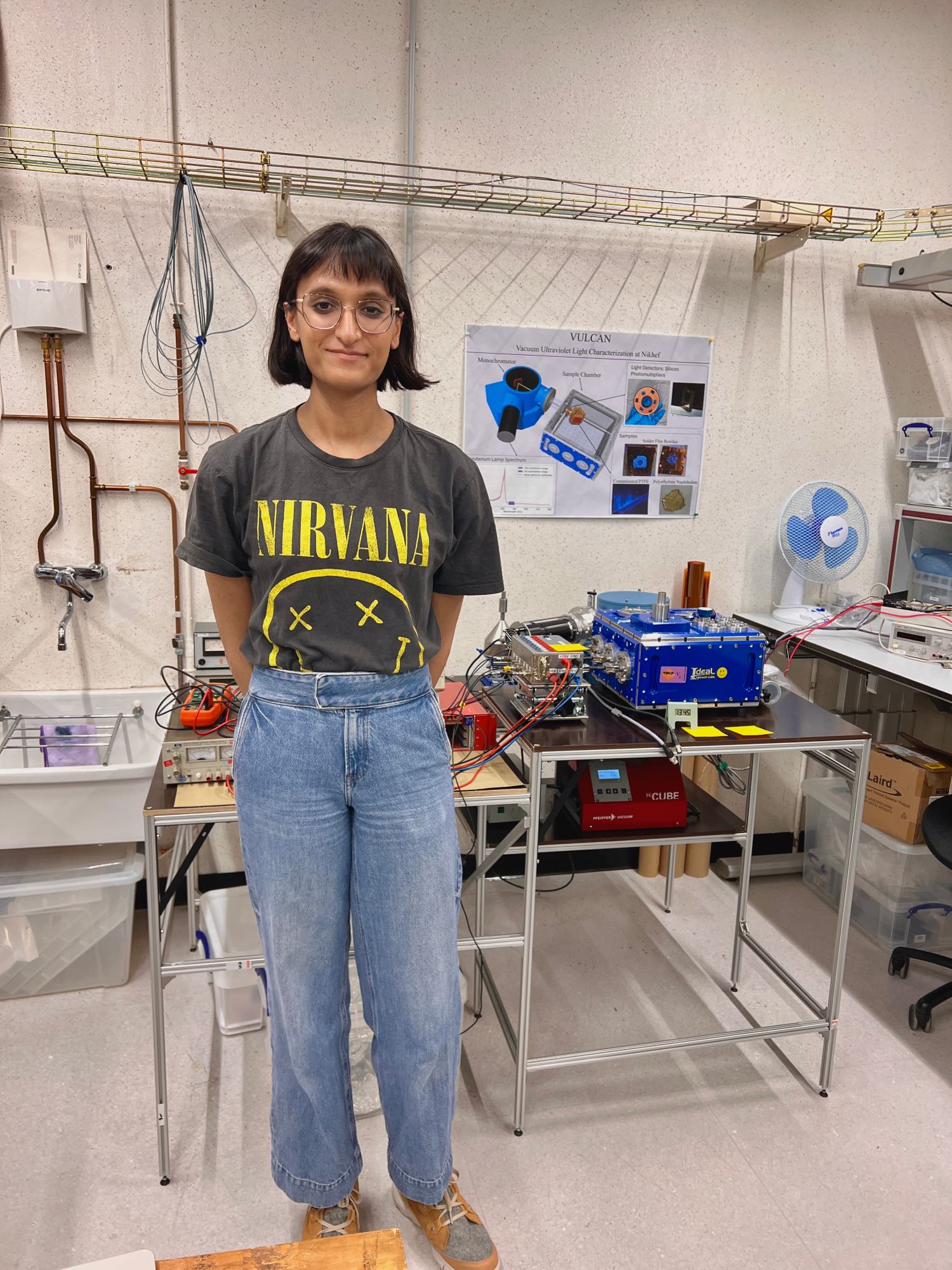
She is closely involved in setting up the VULCAN test rig in the Dark Matter Lab at Nikhef for fluorescence in dark matter detectors. XENONnT is a large detector for dark matter particles located deep underground in Gran Sasso, Italy.
The Dark Matter group is researching the nature of dark matter in the universe, which exerts gravity in galaxies and clusters but does not emit light. It is suspected that this involves a type of particle that is still unknown.
Detectors such as XENONnT use a large volume of liquid xenon to pick up light signals that, in theory, are generated when a dark matter particle from space collides with an atom in the liquid. So far, no such signals have been detected.
In VULCAN, materials for XENON are tested for possible fluorescence that could cause disruptive light signals in the detector. Patel designed part of the test setup and is working with Pollmann and colleagues on its further construction.
She finds the trust and freedom she has been given in the group as a master’s student surprising. ‘Especially since engineering is still quite new to me. “Do your thing,” is what I keep hearing.’
The Olga Igonkina Travel Grant was established in memory of Nikhef physicist Olga Borisovna Igonkina, who passed away in 2019, and is intended to encourage young talent in particle physics. The prize is awarded annually. The jury selected Patel’s proposal, described as ‘ambitious’, from six nominations.
With the grant, Patel will travel to the AstroCeNT institute in Warsaw, Poland, in early March. There, she will spend several weeks conducting tests with a nanosecond pulse UV laser, which will further complement measurements in Amsterdam in the microsecond range.
Patel, who is about halfway through her master’s degree, says she is delighted with the Olga Igonkina travel grant. ‘When I started my master’s degree, I wasn’t sure whether I wanted to continue as a researcher or whether I was more inclined towards industry. Now I do, mainly because of the independence it offers; a PhD is definitely my next goal.’