A team of Nikhef theorists has published a new study of so-called penguin diagrams that have detailed effects in studies of the asymmetry between matter and antimatter.
The overview in European Physical Journal C is particularly useful now that experiments are looking at differences between matter and antimatter with increasing precision, says lead author Robert Fleischer of Nikhef. “Of course, precision must come from both sides: theory and experiment. This paper contains the 2026 state of the art for theory.”
For this research, Fleischer worked closely with Nikhef colleague Kristof De Bruyn in Groningen and his former PhD student Eleftheria Malami, now a postdoc in Cambridge.
In particle physics, there is an increasing focus on precision experiments to test the validity of the Standard Model. In broad terms, the theoretical description of elementary particles and their interactions is sufficient to predict the outcomes of current experiments. However, the current model does not provide answers to some fundamental questions.
The absence of antimatter in the visible universe is one of the major questions in fundamental physics. In the Standard Model of particle physics, matter and antimatter are equally likely. However, there is only matter in the universe. Why this is so is unclear.
The existence of subtle differences has been clear since the 1960s, when it was discovered that the weak nuclear force does not work exactly the same for mesons and their antiparticles. More recently, it has been discovered that regular matter particles (with three quarks) also differ from their antiparticles.
Physicists refer to this as CP violation. Antiparticles have the opposite charge of particles, with all other properties mirrored. However, measurements show that this theoretical symmetry is not perfect in some processes.
Conversely, measuring CP violation may provide clues for improvements or extensions to the Standard Model. For this reason, CP violation is an important research topic in experiments at CERN and elsewhere.
In particular, researchers often focus on B mesons, particles consisting of one quark and one antiquark, one of which is a beauty quark. Among others, the LHCb experiment at CERN, one of the Nikhef programs, is studying these types of particles intensively.
Internationally, a number of accelerator and more specialized experiments, known as B factories such as Belle-II and Babar, are active, and new ones are in preparation, which will look in even greater detail at the subtle deviations in the symmetry of B mesons and their antiparticles.
Fleischer expects a lot from the upcoming upgrade of the LHC accelerator at CERN, which should yield much more measurement data with more intense beams (high luminosity). Detailed research into CP violation is also an important topic in the argumentation for the possible new 90-kilometer FCC-ee accelerator at CERN.
In their new paper, Fleischer, De Bruyn, and Malami summarize the most current insights into first-order corrections via penguin processes on theoretical calculations of B meson decay.
This includes both new theoretical techniques and experimental values from experiments. The article also makes estimates of the contribution that future experiments could make. Parts of these analyses have been included in the documentation of the new European strategy for particle physics, which will be presented in May.
Fleischer: “We are entering an era in which we will see penguins in all their glory. Not as a side issue, but as the main issue. I have been working on this since 1999. So this is a dream come true.”
Penguins?
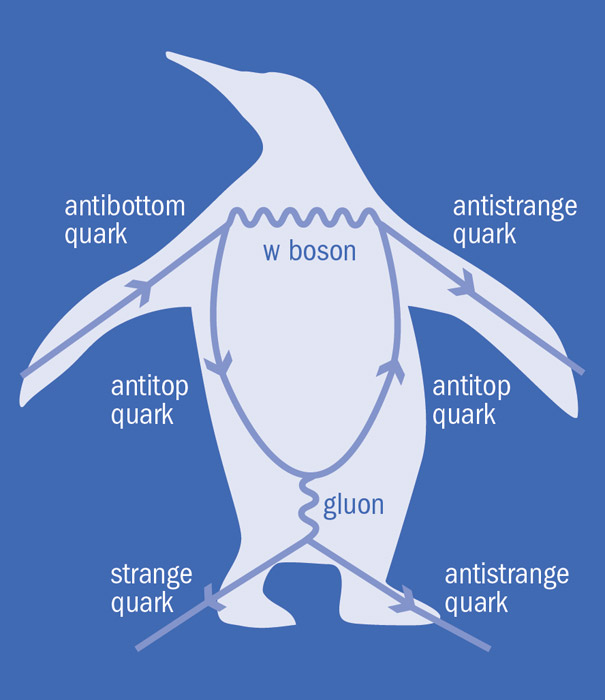 The term penguin diagram comes from CERN theorist John Ellis, who lost a bar bet to colleagues in Geneva in 1977 and therefore had to promise to use the word “penguin” in his next publication. Ellis frankly recounts in his memoirs that after smoking “an illegal substance”, he went to work and suddenly recognized the outline of a penguin in certain Feynman diagrams.
Feynman diagrams are schematic representations of particle interactions, devised by Richard Feynman in the fifties. At the time, Ellis was studying the spontaneous decay of mesons, particles consisting of two quarks, one of which undergoes a quantum transformation.
During this transformation, a force particle is created for a brief moment and immediately absorbed again, causing the diagram to show a loop. Ellis deliberately drew the loops so that they form the body of a penguin, with tracks along the feet and wings. The penguin processes sometimes provide important corrections to the calculation of the main process.
