The world’s collaborating gravitational wave detectors are publishing a catalogue of new observations today. According to the researchers, the GWTC-4 catalogue shows a “kaleidoscope of cosmic collisions”.
The two LIGO detectors in the US, Virgo near Pisa and Kagra in Japan have compiled the earlier first period OR4a of the fourth observation run OR4, which was completed in November, in the new catalogue. This adds 128 new gravitational waves to the existing list, which contains hundreds of observations.
Exceptional events have been found, from supermassive colliding black holes to extremely fast-rotating black holes, the loudest gravitational wave ever, or a collision of black holes with very different masses. The growing number of observations makes it possible to develop statistics on types of black holes and on space-time itself under extreme conditions.
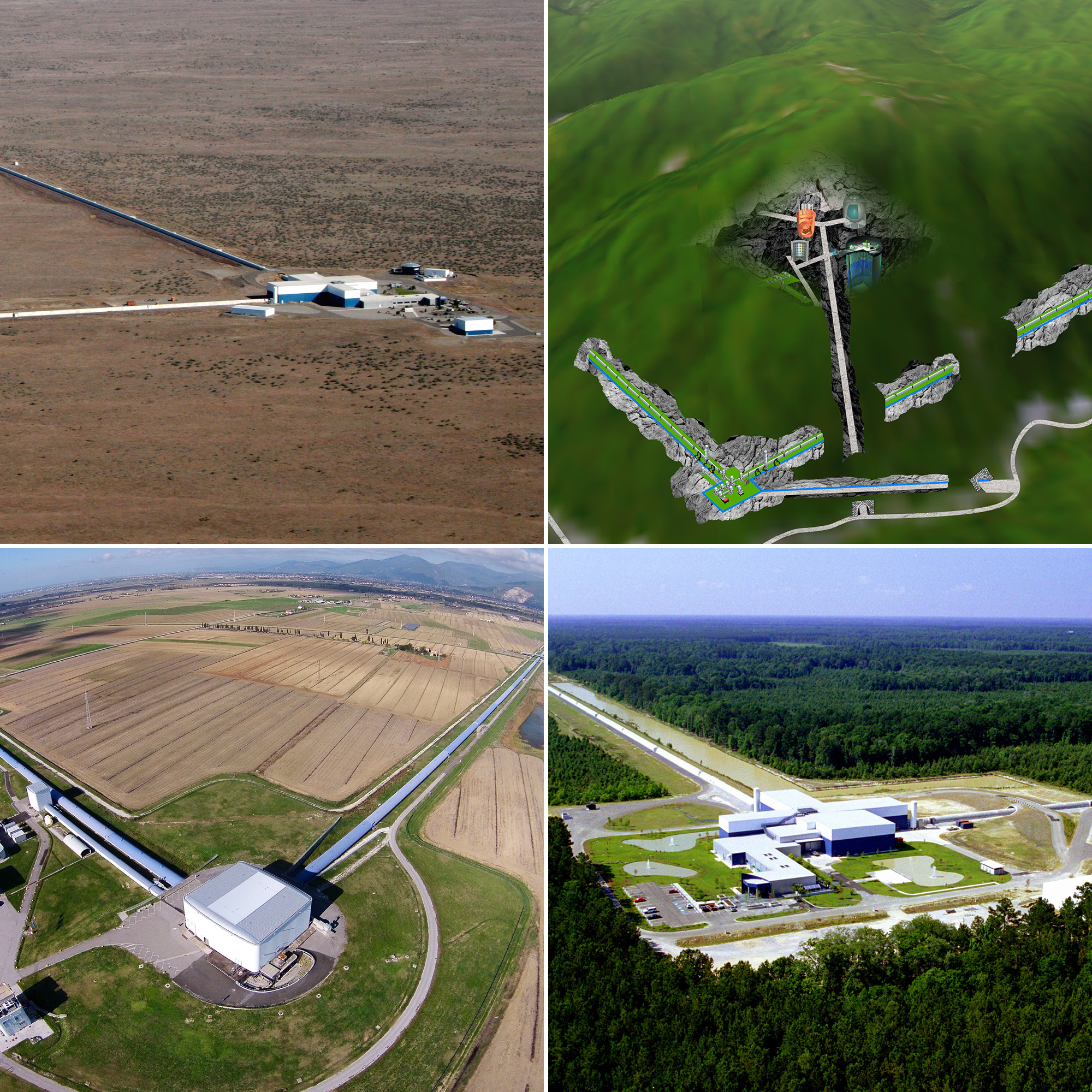 Nikhef is a partner in the LIGO/Virgo/Kagra collaboration, both through contributions to the Virgo detector in Italy and through participation in the analysis of the measurements. Nikhef is also working on new initiatives such as the LISA space detector and the Einstein Telescope.
The new supplementary catalogue is published in Astrophysical Journal Letters, together with a series of articles on a number of striking results. These include a new estimate of the expansion of the universe, which has been an intense topic of debate in astronomy for years.
Gravitational waves are vibrations of space itself, caused by the rapid movements of extremely compact objects in the universe, such as black holes or neutron stars. In 2015, such a gravitational wave was observed for the first time via minute movements in a kilometre-long interferometer, originating from colliding black holes.
Since then, the LIGO detectors, Virgo and Kagra have observed hundreds of vibrations, and the signals have been analysed jointly. The shape of the waves provides a wealth of information about the properties of the sources in the universe.
According to the researchers, the new catalogue provides an even better picture of the enormous variety of sources of gravitational waves in the universe. This allows astrophysical theories about black holes and the General Theory of Relativity itself to be tested in detail.
One of the most striking results of the new list and studies is an estimate of the so-called Hubble constant. This number is a measure of the speed at which the universe itself is expanding.
In astronomy, there are various ways to measure this speed, but so far the results have varied widely. The most important estimates are those from the Planck satellite via cosmic background radiation, and a higher value based on the speed of variable Cepheid stars and supernovae. Planck measured 67-68 km/s/Mparsec. The Cepheid studies report 73-74 km/s/Mparsec.
An independent analysis by LIGO/Virgo/Kagra of all gravitational waves detected to date yields a result of 76 kilometres per second per megaparsec. This is close to the estimate based on variable stars. The fact that no complex calibrations are required for the new estimate is a significant advantage, according to spokesperson Stephen Fairhurst of LIGO/Virgo/Kagra in an explanation.
