Maastricht University has become a full member of the international LHCb experiment at CERN. The university was already an affiliated member of the collaboration through Nikhef.
This was announced in Maastricht. In its new position, the Limburg LHCb group will have a say in decision-making on the experiment’s collaboration board. Until now, VU University Amsterdam and Nikhef were full members, and the University of Groningen was an associate member via Nikhef.
Maastricht University has been a member of the national Nikhef partnership for subatomic physics since 2017. The university now has a Faculty of Science and Engineering (FSE) and the Gravitational Waves and Fundamental Physics research institute. The LHCb group is a member of this and has more than ten members.
Team leader Jacco de Vries emphasises that the LHCb group in Maastricht will continue to collaborate with Nikhef as an independent member of the experiment.
Full membership makes Maastricht’s contribution to LHCb more visible, says De Vries. The group plays an active role in LHCb in the implementation of the experiment at CERN, theory development and software.
There is also an important connection with the Department of Advanced Computing Sciences in Maastricht, which works on AI, massive computing and quantum computing.
De Vries: ‘Membership does come with more responsibilities, especially in view of the upcoming upgrade of the experiment.’
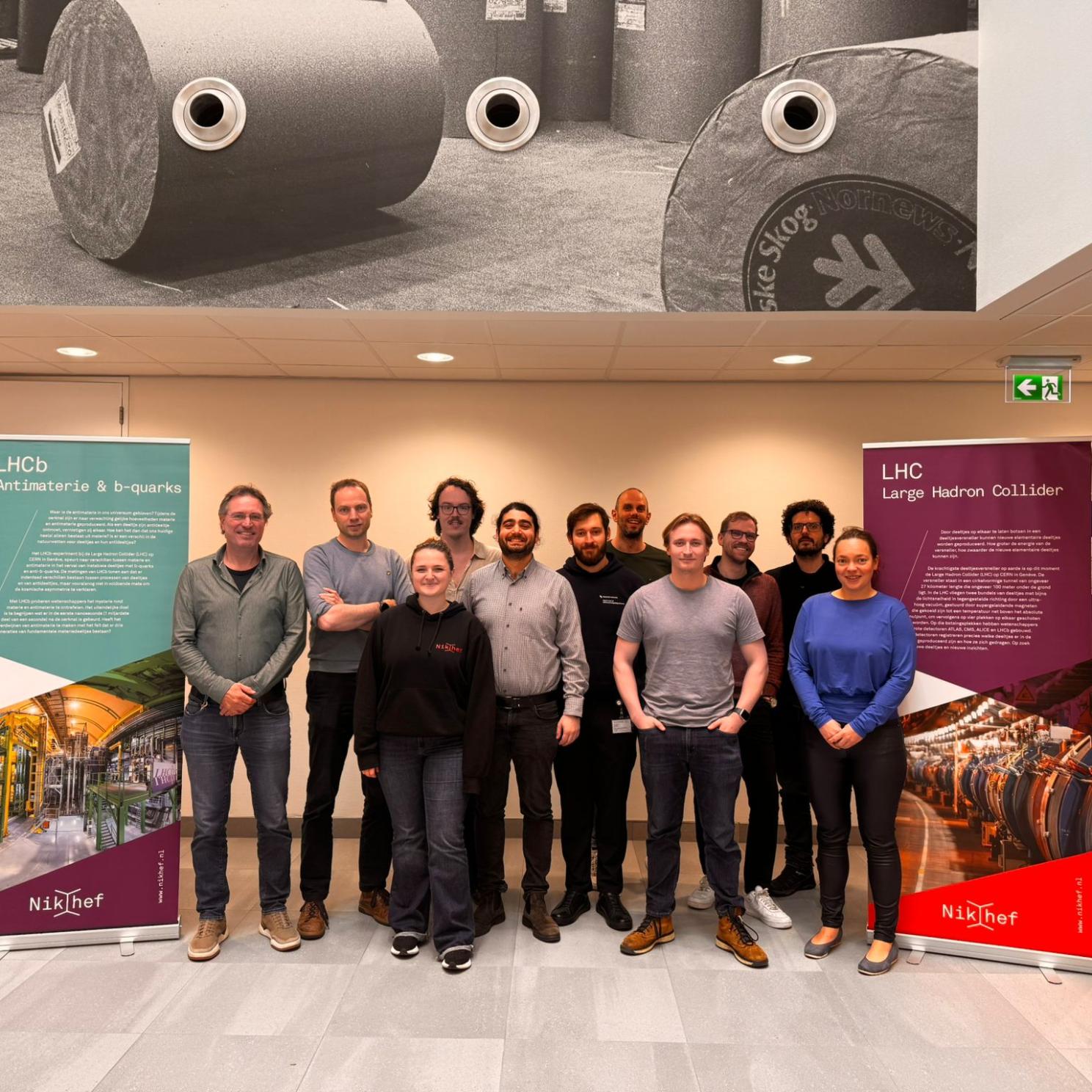
LHCb is one of the four major detector experiments in the LHC particle accelerator at CERN. LHCb research focuses in particular on differences between matter and antimatter and the question of why the universe appears to contain only matter.
In addition to particle research within LHCb, the Maastricht research institute GWFP within Nikhef is also active in the field of gravitational wave research. Among other things, the ETpathfinder is being realised in Maastricht, a test setup for technical innovations for gravitational wave detectors, such as the planned Einstein Telescope.
