The LHCb experiment at CERN has demonstrated the existence of a new heavy proton-like particle. It is the first discovery made with the detector in Geneva since it was upgraded in 2024.
The discovery of the new Xi-cc particle, dubbed the heavy proton by researchers, was presented today at the traditional Moriond Spring Conference in France.
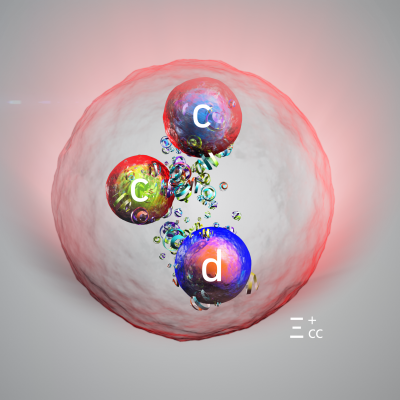 The highly unstable particle contains two charm quarks and one down quark, and at 3620 MeV is about four times as heavy as a stable proton in atomic nuclei. The discovery was made in proton-proton collisions in the LHC accelerator, collected in 2024 in run 3 of the LHC.
The existence of the unstable particle was deduced from measurements of its decay into three lighter particles in the detector. A total of 915 decay events were found. The signal is very significant: 7 sigma, more than enough for the discovery.
The new Xi particle resembles a proton with a “quark upgrade” where two heavier charm quarks are present instead of two up quarks. Charm quarks are heavier relatives of the up quarks from the second particle generation of the Standard Model. They have the same charge and other properties as up quarks, but a greater mass.
The particle is the partner of another Xi particle with an up quark instead of a down quark, which was discovered in 2017 and, in theory, should have almost the same mass. Observing the new particle proved difficult experimentally and was only possible thanks to technical improvements to the LHCb detector.
Nikhef was actively involved in that earlier upgrade of the detector. Nikhef is one of the key partners in the LHCb experiment, in which fifteen countries are collaborating. LHCb is specially designed to study any differences between particles and their antiparticles.
In addition, the LHCb researchers are constantly searching for as yet unknown signals in their measurement data. Nikhef researcher Patrick Koppenburg of LHCb manages a special web page https://koppenburg.ch/particles.html for all newly discovered particles, partly to show that particle physics has continued to make discoveries since the discovery of the Higgs particle in 2012.
His counter currently stands at 80 particles, most of which are extremely unstable. The discoveries provide important tests for particle theory, particularly that of the strong interaction between quarks.
Source: LHCb website at CERN
