It may look like Christmas decorations, but hundreds of flashing lights in the Nikhef entrance hall show live the impacts of particles in the deep sea off Toulon, France. The 1:60 scale model of the KM3NeT neutrino detector was built by staff and students.
‘A Friday afternoon project in the spirit of Christmas,’ says Aart Heijboer of the KM3NeT group at Nikhef and professor at the University of Amsterdam. Together with staff and students, they have been working on the model for the past few weeks.
On Thursday afternoon, Heijboer established a direct data connection with the coastal station near Toulon, which has since been feeding real measurement data to the scale model almost live.
Since then, the 33 strings, each with 20 LED balls, in the entrance hall have been displaying the light signals detected by the real detector at a depth of 2,450 metres in the Mediterranean Sea. The 33 strings of detector balls rising up from the seabed there register light emitted by fast-moving particles in the seawater.
In the scale model, the balls light up regularly in clusters that usually move from top to bottom. These are traces of atmospheric muons. Neutrino interactions are much rarer and mainly come from below. ‘If you take the time during the Christmas holidays, you’re bound to see a few,’ says Heijboer.
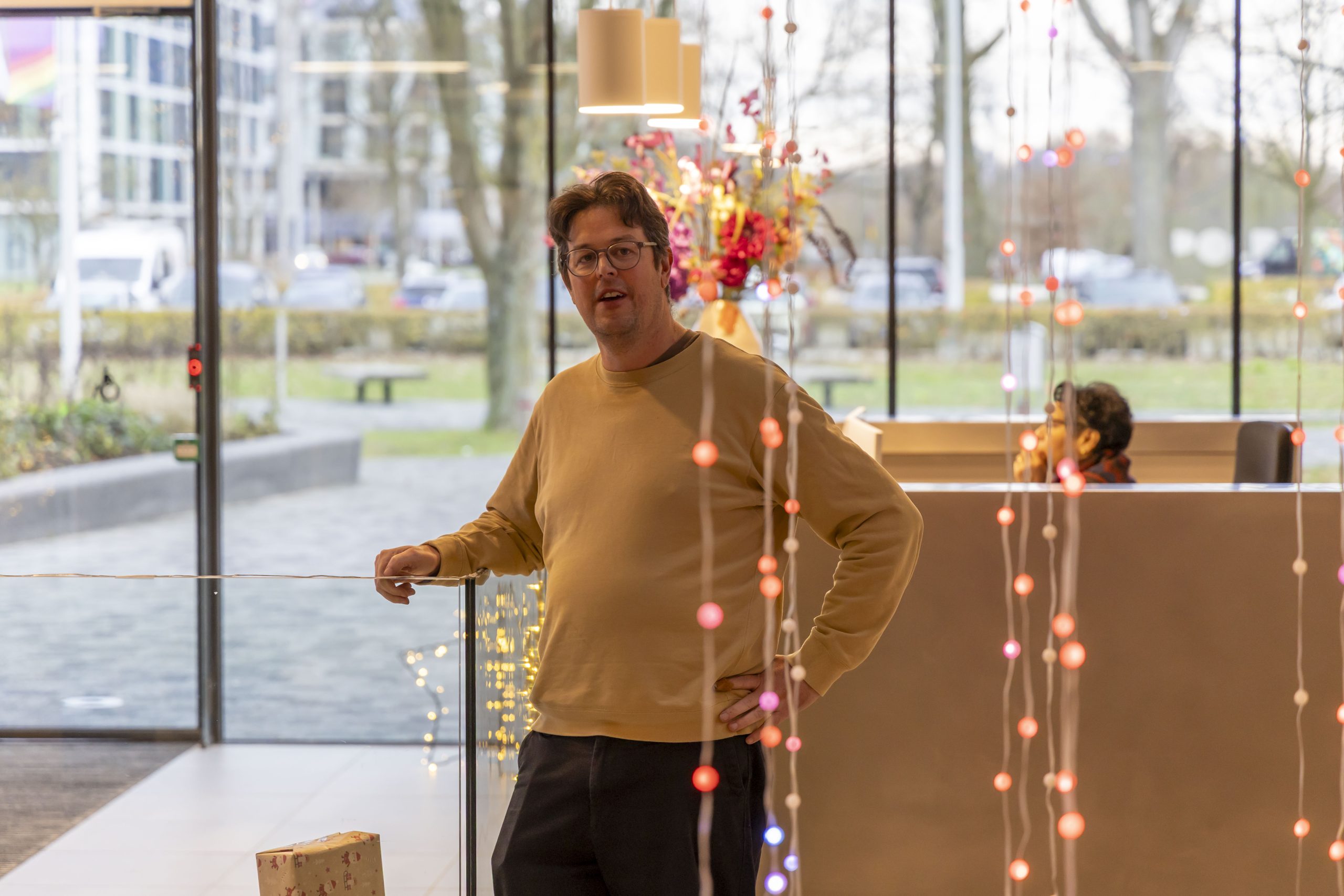
In the real experiment, the light fronts move through the entire detector in milliseconds. In the scale model, this is slowed down millions of times to better see what is happening.
KM3NeT is the largest neutrino detector under construction in the northern hemisphere, with one part in Italian waters (ARCA) and one part (ORCA) in French waters near Toulon. The detectors are intended to study the cosmic sources of neutrinos and the properties of the particles themselves. To this end, a cubic kilometre of dark seawater will ultimately be observed.
Neutrinos are elementary particles that have almost no mass and are only sensitive to weak interaction. As a result, after their creation, they move through most matter at almost the speed of light.
Occasionally, however, a neutrino collides with a nuclear particle in a water molecule, releasing charged particles that cause a light trail in the water. The sensors pick this up, and the arrival times can then be used to calculate the trail of the particles.
NIKHEF is one of the leading institutes in the KM3NeT experiment. In Amsterdam, a large number of the spheres, known as DOMs, are being built.
The KM3NeT scale model will remain in operation until at least the second week of January. The intention is to also show it to the public during the science weekend in October.
Watch the video of the construction and opening of the scale model here.
