Theorists from Nikhef and other institutions have released an updated version of the FORM computer programme. This computer algebra software has been crucial to particle physics for decades. After minor releases, this is the first major new version since 2013.
The new version is tailored to enhanced precision tests of the Standard Model of particle physics. To do these, theorists must make accurate predictions of particle processes, which experiments measure as precisely as possible. Any deviation can provide clues to new, as yet unknown physics.
Such precision calculations depend on manipulating algebraic expressions with billions of terms, far beyond the limits of commercial computer algebra software. FORM is unique capable to handle such extreme challenges. It processes expressions efficiently, even when they no longer fit in computer memory.
FORM was developed in the 1980s by theoretical physicist Jos Vermaseren at Nikhef to perform algebra with very long expressions. The programme is a successor to the earlier Schoonschip programme by Nobel Prize winner Martinus Veltman.
FORM has played a decisive role in many groundbreaking results in modern particle physics, for example in calculations in quantum chromodynamics of quark distributions in protons.
 In the new European strategy for particle physics, FORM is praised as a crucial tool for analysing and interpreting data from the Large Hadron Collider, a fact that is not always well known to researchers.
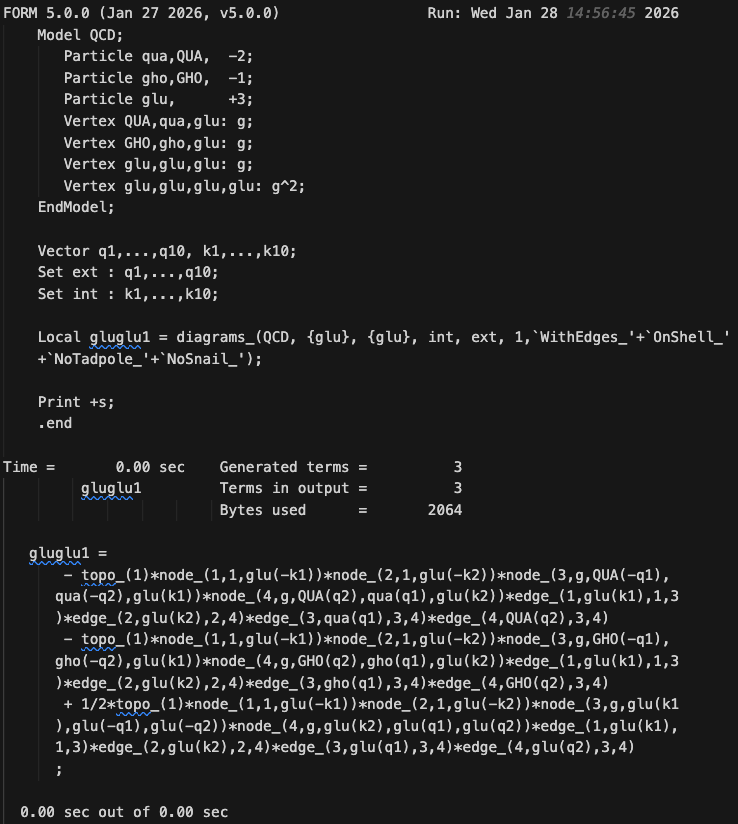
The new version 5 of FORM supports even higher precision calculations and has been given a number of important new features. The most notable is the addition of a generator for Feynman diagrams for particle processes. Until now, this always required additional external tools, which made the workflow cumbersome. FORM 5.0 also enables floating point calculations with arbitrary precision. In addition, there is now a direct interface to important software libraries.
Besides Nikhef emeritus Jos Vermaseren himself, Joshua Davies, Toshiaki Kaneko, Coenraad Marinissen (Nikhef) and Takahiro Ueda were also involved in the update. The FORM software and documentation are open source and available via GitHub.