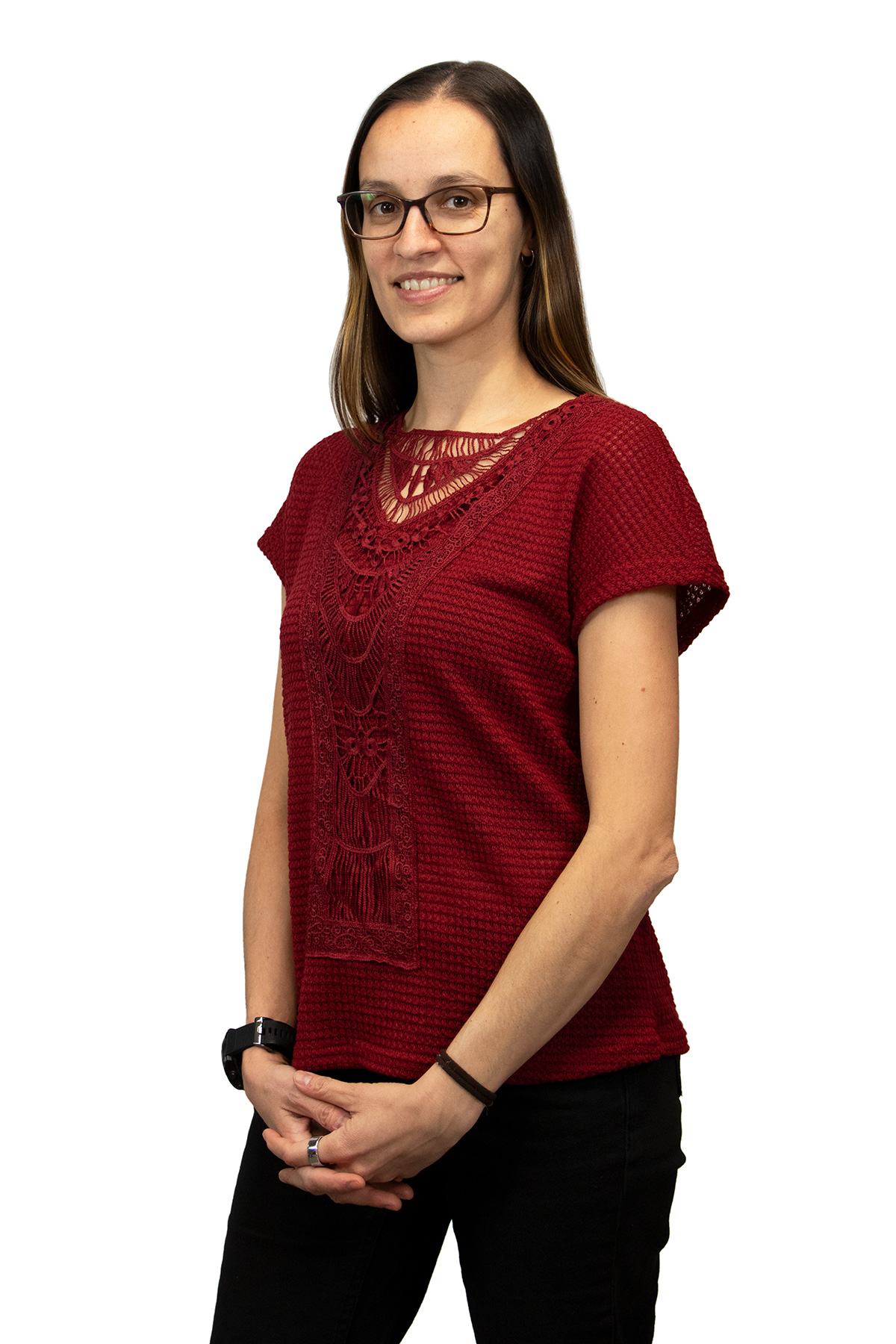
INTERVIEW Starting in april, particle physicist Flavia de Almeida Dias has been appointed as new programme leader of the ATLAS experiment at Nikhef.
De Almeida Dias, who is originally from Brazil, will lead the ATLAS group alongside deputy programme leader Ivo van Vulpen and the Nijmegen-based ATLAS programme leader Frank Filthaut. The group comprises around fifty researchers, PhD candidates, master and undergraduate students and is the home base for the substantial Dutch contribution to the ATLAS experiment at CERN.
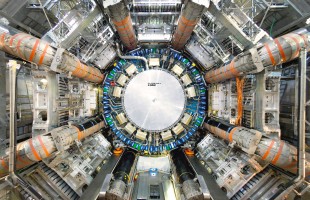
ATLAS is the world’s largest particle detector, based at CERN. The detector with which the Higgs boson was discovered in 2012, and countless details of particle theory are tested and scrutinised.
De Almeida Dias studied in São Paulo, worked on the CMS experiment for Brazilian and American universities at CERN and came to the Netherlands six years ago. She lectures at the University of Amsterdam and is a Nikhef staff member in the ATLAS group.
On 1 April, she will succeed the current programme leader, Wouter Verkerke, who will be focusing on artificial intelligence across Nikhef but will remain associated with ATLAS for part of his time.
She didn’t apply for the role, says Flavia de Almeida Dias on the eve of her appointment in her modest office at Nikhef. “I did indicate that I was interested, but also that it would be fine if other colleagues took it on. I never saw myself as the boss. But in my view, the process was careful and everyone was heard. I’m happy to have the confidence of the group and the director to take the position.”
Group leader but not the boss, then?
“Above all, it’s a wonderful opportunity to work on the future with a perfect group of people. Lovely people. With good group dynamics. With little hierarchy; everyone gets involved. The ATLAS group is exactly the kind of group I’d like to lead. And there’s a lot going on.”
Exciting times to be taking up the post?
“Challenging. We’re working hard on analysing available LHC data. And all sorts of projects are needed in preparation for the high-luminosity LHC, from hardware like the trackers to software and algorithms. Shaping that together is my commitment.”
And a big undertaking to lead.
“At CERN, I was the exotics convener for a number of years, during which I coordinated five hundred people from all over the world on searches for new particles. All people with their own projects and passions, where we had to agree on priorities together. That was hard work, long hours, becoming friends. But we managed it.”
So leading a group of fifty might not be such a huge task after all?
“Well, you can bet it’ll be a lot of work. As a convener, you’re not the people’s employer, your main job is to bring them together and keep them together. The goals are focused in the short term scientific output. As programme leader at Nikhef, you are formally the line manager of some of the team members, there is a much wider range of responsibilities and the group’s vision covers a much longer period.”
Still time for your own physics?
“Perhaps not as intensively as I do now, but at ATLAS everything ultimately revolves around physics. As a group leader, you might be less involved in the finer details, but you’ll be involved in many more topics. You’ll be talking to everyone. And I’ll continue teaching at the UvA. With students who sometimes just ask a brilliant question. I’m actually looking forward to it.”
On a personal level too?
“For me, physics is a human endeavor. Literally, people working together on problems and challenges. I love people. And I know how important it is to value people for who they are. Inclusion and diversity are issues I’ve been concerned with for a long time. I know exactly what it’s like to be the only woman in a group, for example, and I don’t want anyone in my team to feel singled out. When people feel at ease, they perform better.”
How do you achieve that?
“With small things. When you meet new people, don’t just ask about their research, but also where they’re from, their hobbies and their pets. You should show you care about them as a person.”
So where does Flavia de Almeida Dias come from?
“From a small provincial town in Brazil. From a family where, before my generation, going to university was not the norm. But I was a super curious girl who wanted to know and understand everything. My grandfather and I read Carl Sagan’s books together. I was top of the class in the entrance exams, got a scholarship, and was able to study. Some of my fellow students had parents who are academics, I didn’t. They knew how to study, how to play the game; I had no idea, but just copied their proactive way to interact with university and research and seized every opportunity.”
Why particle physics?
“That actually only came about during my final internship. First I was working at a proton accelerator in Brazil for material studies. It was incredibly exciting; we were examining the paint from famous paintings that were brought in under police guard. But I actually futon the accelerator even more exciting than the art. During my last year in my bachelors, I saw an advert somewhere for the CERN supper school, was invited, and from there continued my studies in the field.”
At the CMS experiment, of all places – ATLAS’s rival.
“Haha, yes. Eventually, after finishing my PhD. I switched to ATLAS via a post with Edinburgh University. That seems like quite a leap, but in fact you’re talking about exactly the same physics, just with a completely different detector. Fundamentally, there isn’t much difference. Sometimes we work together, to be able to combine more measurement data.”
What’s it like having shared group leadership?
“I think it works really well. Frank Filthaut is hugely experienced, and additionally brings invaluable expertise in the management of detector projects. And my deputy, Ivo van Vulpen, knows the group inside out and is a brilliant sparring partner for things you’d otherwise have to figure out on your own.”
Final question. Will this shared office remain your workspace?
“Wouter is keeping his room at the end of the corridor; that’s what we’ve agreed. Including his light pink artificial Christmas tree. That’s a personal thing for him. Well, I don’t really need a corner office anyway. So: yes, this will remain my office.”
(Interview by Martijn van Calmthout)