The interaction of the heaviest known particles may offer insight into processes beyond the reach of existing accelerators. NWO is funding new research into the dance of top quarks with Higgs particles.
Marcel Vreeswijk and Wouter Verkerke of the University of Amsterdam and Nikhef have received an Open Competition M2 grant from NWO for two new PhD students, who will use new techniques to study the interactions of top quarks and Higgs particles. This has been announced by NWO.
Top quarks are the heaviest particles known to physics, with Higgs particles coming in second. The masses of these elementary and highly unstable particles are on the order of the mass of an entire gold atom. The top quark is one of the building blocks of matter, while the Higgs particle, discovered in 2014, gives all other particles their mass.
On paper, thanks to new theoretical techniques, the interactions between these superheavyweights are particularly sensitive to physical forces or particles that are beyond the reach of existing accelerators. Until now, these interactions have not been known in great detail because they are so extremely rare. This makes it difficult to detect any subtle deviations in their behaviour.
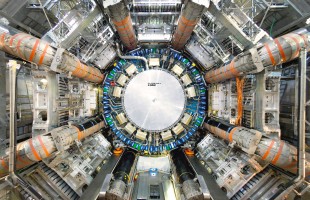
The new research project aims to gain a better understanding of these interactions and to investigate whether there are any unknown influences at play. To this end, existing measurements from Run-3 with the ATLAS detector will be re-examined, using artificial intelligence and machine learning, among other techniques.
In the current experiments in ATLAS, proton collisions are mainly used to search for Higgs particles and top quarks separately. Vreeswijk and Verkerke want to map processes in which both a Higgs and a top quark are involved.
The problem with this is that both the top and the Higgs decay almost immediately, leaving traces in the detector among traces from countless other processes or collisions. New techniques from artificial intelligence should help to still distill them from the sea of particle traces.
This is also in line with Nikhef’s new focus on AI techniques and methods, which are playing a major and fast-growing role in particle physics.