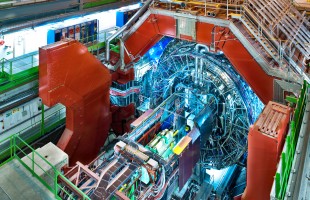
The plasma’s of quarks and gluons produced during lead-nucleus collisions in the LHC accelerator is thought to exist in lighter nuclei and even in colliding protons. This is reported by the ALICE experiment at CERN.
In a new analysis published in Nature Communications, researchers from the ALICE collaboration report a striking similarity between patterns in proton-proton, proton-lead and lead-lead collisions. “The size of the colliding systems does not determine the formation of quark-gluon plasmas,” they conclude.
The ALICE experiment studies these complex collision processes. Through Utrecht University, Nikhef is a prominent partner in the research programme with ALICE.
Quark-gluon plasma is the form in which extremely hot and dense matter existed microseconds after the Big Bang. Until now, this plasma has mainly been studied by firing heavy ions at each other, including at CERN.
It was thought that in smaller systems, the pressure and temperature would be insufficient to produce a plasma of quarks and gluons.
For the analyses, ALICE observations from the period 2016–2018 were examined in detail. In the LHC accelerator at CERN, heavy ions such as lead are usually accelerated for a few weeks each year for special experiments; for the rest of the year, protons are used.
A strong indication of the formation of quark-gluon plasma is the so-called anisotropic flow, in which the particles created from the boiling plasma during the collision move predominantly in a certain direction.
As the plasma cools, the quarks form baryons with three quarks and mesons with two quarks. It is already known from the lead experiments that the heavier baryons move in a more concentrated manner than the slightly lighter mesons.
According to the new analyses, this difference is also evident in collisions of protons with lead and even in colliding protons. According to the researchers, this is an indication that the same, comparable expanding quark systems play a role in all collisions.
In late 2025, ALICE conducted its first experiments with colliding oxygen nuclei in the LHC accelerator, which are much lighter than lead ions but heavier than protons. “We expect these measurements to bridge the gap between proton collisions and lead collisions, enabling us to learn more about the nature and evolution of the quark-gluon plasma.”
The analyses of the oxygen collisions in ALICE are expected later this year.