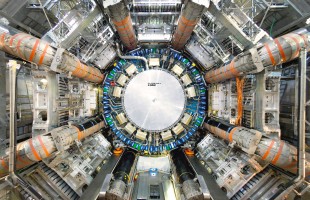
The two major experiments at the LHC accelerator at CERN have combined their measurements of the simultaneous production of two Higgs particles in proton-proton collisions. Insiders describe the result as promising.
The creation of two Higgs particles in proton-proton collisions in the current LHC accelerator at CERN is theoretically possible, but extremely rare. By combining measurement data from the two experiments, more reliable statistics can be obtained.
In 2012, both ATLAS and CMS demonstrated the existence of the Higgs particle, the particle associated with the theory that gives elementary particles mass via an omnipresent field. The long-predicted Higgs particle is the final piece of the Standard Model of particle physics.
Since then, the discovered particle has been the subject of intensive research, particularly to map the shape of the associated Higgs potential. The interaction between Higgs particles is a key factor in this and an important research topic, including within the ATLAS group at Nikhef.
A key question in this context is whether the Higgs potential might exhibit structure at higher energies. This is not apparent in the individual Higgs measurements. Structure could potentially imply that the universe is, in principle, unstable and could vanish at any moment.
At the annual Moriond particle physics conference in the French Alps, ATLAS and CMS presented their first joint results on Monday regarding the search for double-Higgs events. These results are based on data from both experiments collected between 2015 and 2018, known as Run 2 of the LHC accelerator.
When combined, these data reveal tentative indications of the existence of double-Higgs events. Such pairs arise mainly from the fusion of gluons in protons colliding at high energy.
The statistical significance of the signal now detected is 1.1 sigma. In particle physics, this is at most a hint of an effect; only at more than 5 sigma is it truly demonstrated.
Nevertheless, it is a promising indication, says ATLAS researcher Tristan du Pree of Nikhef. He is closely involved in an NWO-funded effort to study double and even triple Higgs events.
Du Pree: “If we can already find a hint in this relatively small dataset, it bodes well for the LHC Run-3 experiments that are yet to be analysed. More data will make the picture of the shape of the Higgs potential much clearer.”
From this summer, CERN will conclude the current LHC Run 3 to make adjustments for proton beams of much higher intensity, the HL-LHC project. According to the schedule, the upgraded accelerator will be available for experiments again from 2030.