STate transition Diagram
Introduction to State Transition Diagrams (STD's)
An STD is a way of describing the time-dependent behaviour of a system. The basic consistency rule is: "A system's behaviour in any state must be the same, no matter by which path the state is arrived at".
States:
- A state is an observable mode of behaviour of the system.
- At any time a particular STD can only be in one state.
- .. but a system's behaviour could be described by more than one state transition diagram
Transition conditions:
- internal events or events external to the system
Transition actions:
- actions in response to the events
- triggering one-shot actions
- synchronizing between different STD's
- producing control outputs
Drawing STD's:
- Identify observable states of the system
- Select the states with normal behaviour
- Specify the conditions that mark a transition
- Specify the actions to produce the observable behaviour in the destination state for each transition
- If the system is complex, partition the diagram in several STD's
The classical elevator example:
- just one lift
- one floor can be requested at a time
- no call buttons on any floors
- the lift waits at the requested floor for five minutes if no-one selects a floor. Then it returns to the ground floor.
- There is a photocell protection on the doors
- The lift will not move with the doors open
STD's:
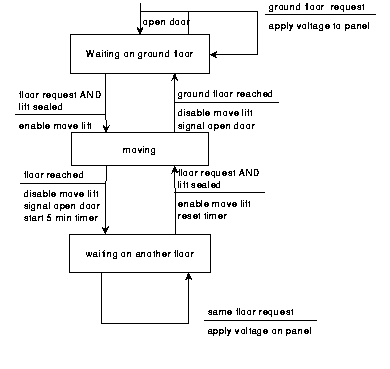
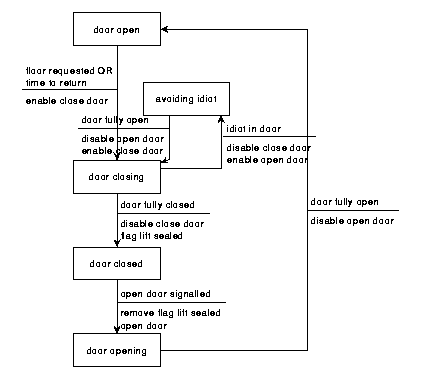
A graphical tool is used to produce the diagrams: TCM ( http://wwwhome.cs.utwente.nl/~tcm/ )