
| Publications | Home | Belle | LHCb |
| Patrick Koppenburg's Talks and Publications | |||

Penguin Hunting[Voyez la version française] |
| Particle physics |
More accurately I am a particle physicist. I am working in huge research lab trying to understand the intimate life of matter and energy. We boost well-known particles like electrons and protons to speeds close to the speed of light and collide them to create other particles. Our goal is to be able to answer fundamental questions like "what are we made of?" or "how does it stick together?". More precisely we would like to design a theory that explains how matter is built. This theory and its consequences would then be taught in universities to future generations of physicists, but also engineers, chemists, biologists, etc. That's about the main point of fundamental research: Understand the basics and communicate them to people who can use this knowledge to produce other knowledge, eventually inventing something really useful.The latest gear advertised in geek's magazines in still based on quantum mechanics and relativity, fundamental research made 100 years ago. What's coming next? Back to our theory. Actually it already exists for more than 30 years. It's called the "Standard Model" and it allows to make extremely accurate predictions that have never been challenged by experiment. A very good model indeed! But yet it's wrong.
There are many other things to criticise in the Standard Model but I don't want to go into too much details. In any case there seems to be a consensus among physicists saying that the Standard Model is fine as long as you don't go to too high energies. The Standard Model is a small part of a more general theory. But this theory, this extension of the Standard Model, is still awaited for. There are many candidate extensions available on the market. They are models extending the Standard Model that are neither confirmed nor disprove by experiment. Most of them predict the existence of new particles that are not yet observed. The future LHC collider at CERN near Geneva will try to find these new particles. The only thing we know for sure is that it will be very difficult. |
| Radiative penguins |
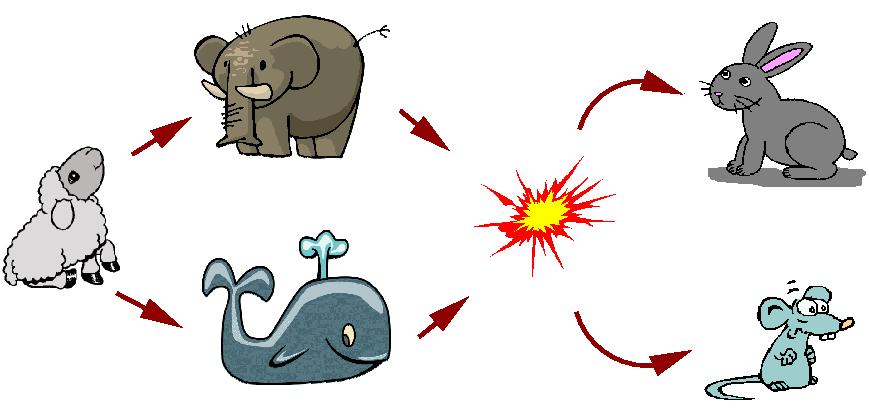
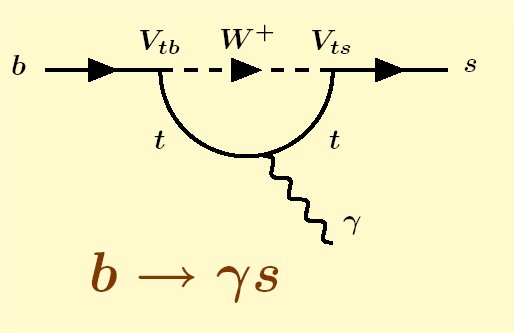
In this case penguins are not birds but a category of particles decays. It's an almost magic process. Imagine a sheep. By some magic process, transform it into a whale and an elephant. Then collide the elephant and the whale until they transform into a rabbit and a mouse. What you get is sheep gets mouse plus rabbit. You think it's impossible? For sure it is for sheep, but not for particles. They do that all the time. The problem is that the process is so fast you never see the whale and the elephant. |
|
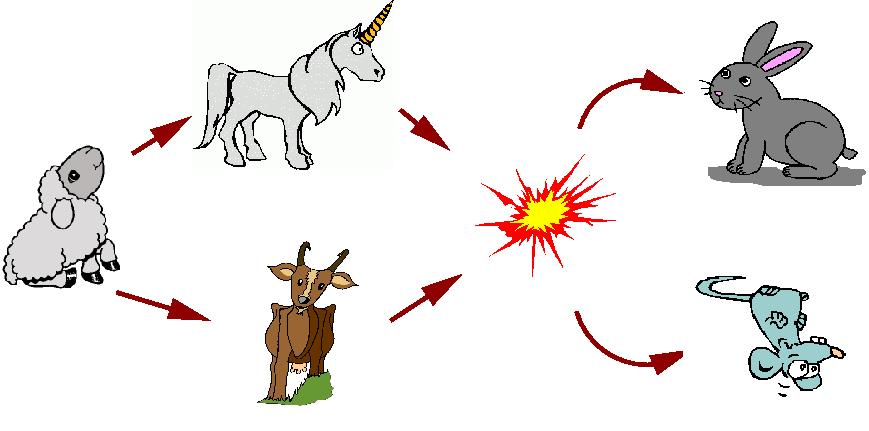
What would happen if one would replace the whale and the elephant by some other
more exotic animals? Usually it doesn't work because it violates some well
established rule.
But a mad sorcerer could predict that the sheep to rabbit and
mouse process could also occur mediated by a unicorn and a
dahu(2) instead of the whale and the elephant.
Imagine the shepherd notices that a sheep has decayed to a
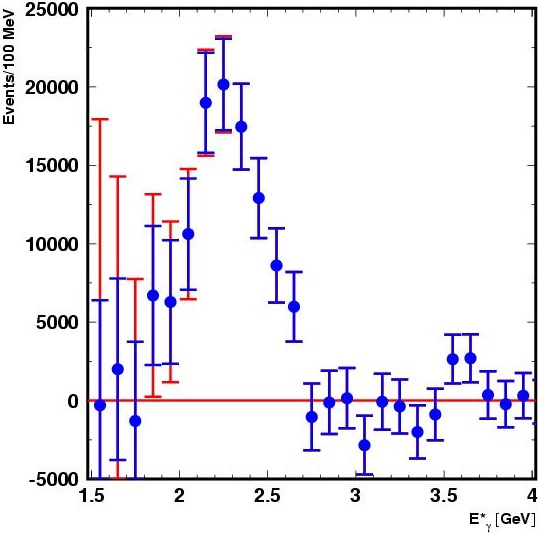
Sounds strange, but that's what physicist do. There are many scientific papers that predict that the rate of the b → s γ decay should be larger than what the Standard Model predicts. My modest contribution to this debate was to measure this rate as accurately as possible. I went to Japan to join the Belle experiment, a collaboration of 300 physicists from around the globe. There we measured a probability for this decay of 0.0355 ± 0.0046 %, which is not much. It's actually very close to the value predicted by the Standard Model (0.038%), which upsets all the physicists who would like to see the Standard Model challenged. |
|
| The energy spectrum |
|
| Semileptonic penguins |
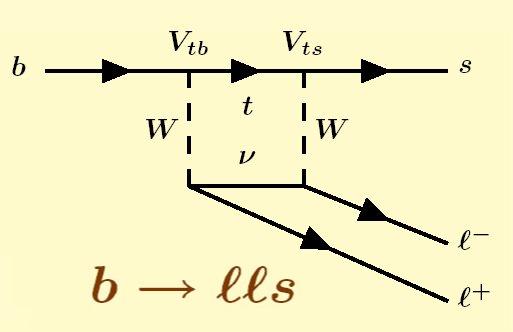
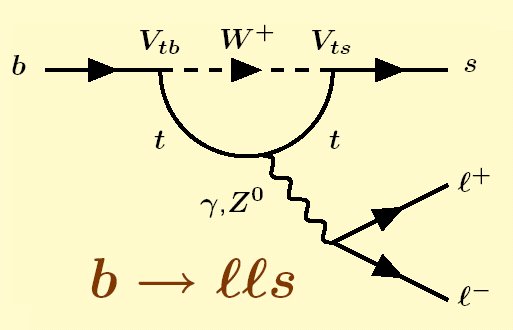
The big disadvantage is that this decay is a 100 times more rare that the radiative counterpart, that already had a probability of 0.04%. It is therefore very difficult to observe. Belle has collected a few hundred cases so far, which is not enough for statistic treatments. But with the huge power of the LHC we are able to measure the angle between the trajectory of the leptons (the ducks) among others. This will tell a lot more about whales and elephants or dahus and unicorns than the bare measurement of the decay probability, as we did in the radiative case. |
| Why "Penguins"? |
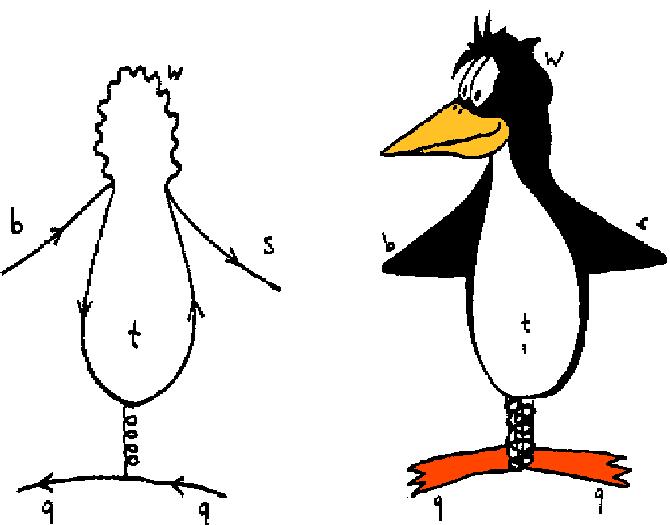
Since then many physicists have distorted these poor diagrams in all possible ways to make them look like penguins. I like the one shown here, which was given to me by Tobias Hurth, another CERN theorist. |
| References |
A few papers:
For the general public:
(1) Never heard of the dahu? Check it out on Wikipedia. It's somehow similar to the Scottish wild haggis. |
 When I am asked about my research interests I sometimes claim I am
a penguin hunter. But don't picture me spending my life on Antarctic's ice
fields. I am a physicist and I prefer the offices with central heating
you can find in research labs.
When I am asked about my research interests I sometimes claim I am
a penguin hunter. But don't picture me spending my life on Antarctic's ice
fields. I am a physicist and I prefer the offices with central heating
you can find in research labs.

Certaines images viennent du grand monde du préscolaire (si,si!)